







- Retirement
Can you retire on $1 million?
 Sam7 min read
Updated
$1 million used to sound like a lot. But in an age of trillion-dollar companies, is it really enough to retire on? We modelled four different scenarios in Canwi to find out.
If someone retired today with $1 million in super and a paid-off home, could they live a comfortable retirement? The short answer is yes - but the details matter a lot. How you draw down that money, what your lifestyle looks like, and whether you're willing to lean on the Age Pension all change the picture significantly.
One important constraint upfront: if all your money is in super, you can't access it before age 60. So the scenarios below start at 60 - no early retirement in your 50s on this balance. We've modelled four different approaches to show the range of what's possible.
These scenarios are completely hypothetical and aren't an exhaustive list. They're designed to show how different priorities - spending, gifting, lifestyle, and housing - play out over a retirement horizon.

Scenario 1 - Deevee: spend big until 67, then taper off
Deevee is 60 years old with $1 million in super and a paid-off apartment. We modelled her expenses at $55,710 per year based on the ASFA comfortable retirement standard. She's fine drawing her super down to zero by age 85, and she'll sell her apartment or take on a reverse mortgage to fund aged care if she needs it later.
For context, her apartment is modelled on a 2-bedroom apartment in Surry Hills based on this tiktok:
Watch this video on TikTok
Here's what that property looks like in terms of price growth:
2-bedroom apartment, Surry Hills NSW
| 1996 | 2026 |
|---|---|
| $205,000 | $1,500,000 |
Deevee wants to holiday every year for the first 7 years until the Age Pension starts to kick in, then every second year until age 84. She starts with a 7% withdrawal rate from her super (invested in a balanced portfolio), then from age 67 draws down the remainder by age 85.
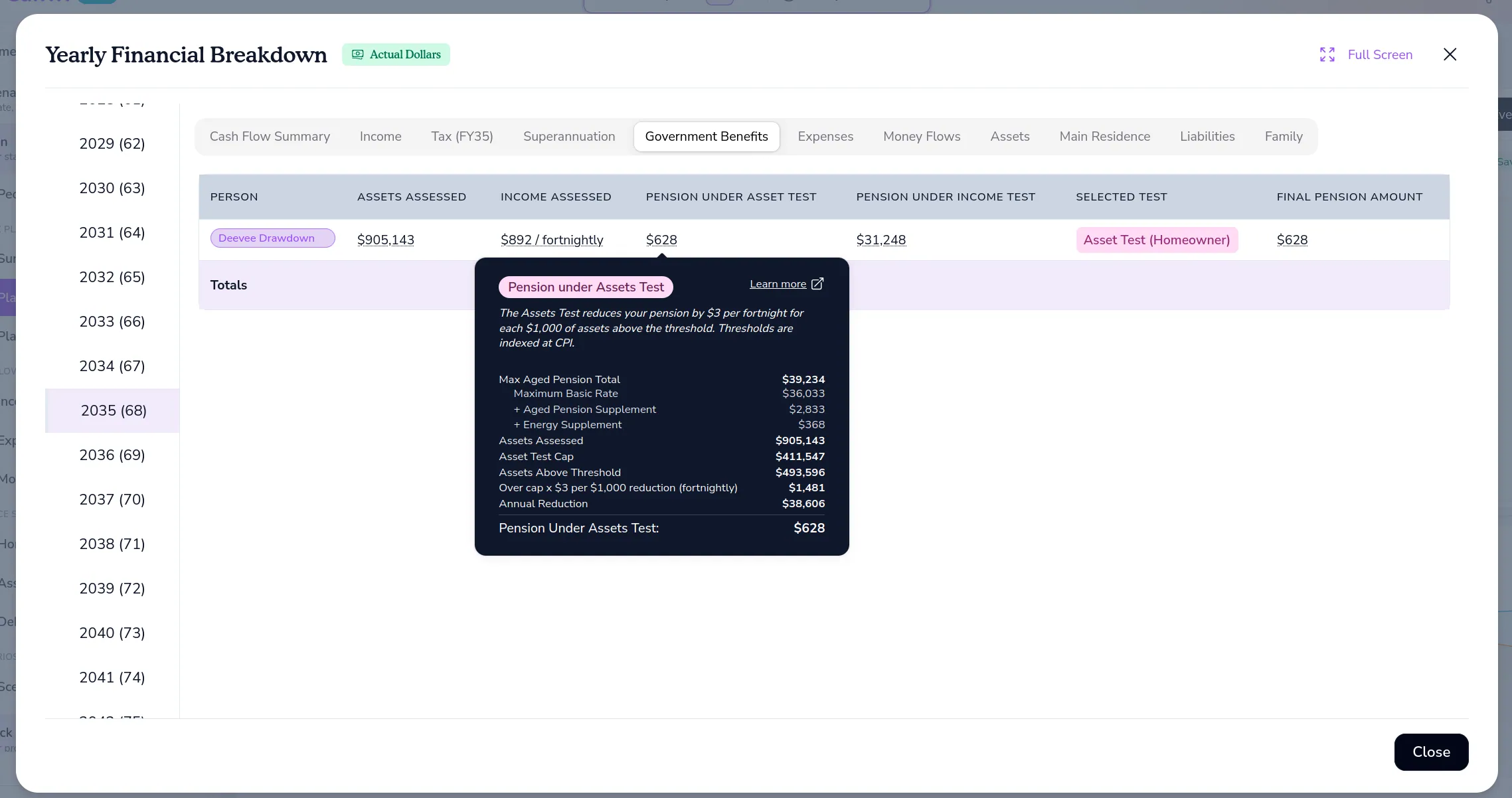
She won't receive much from the pension at first - it starts at around $628 when she's 68 - but it grows to the full pension by the time she's 85 as her super balance reduces.
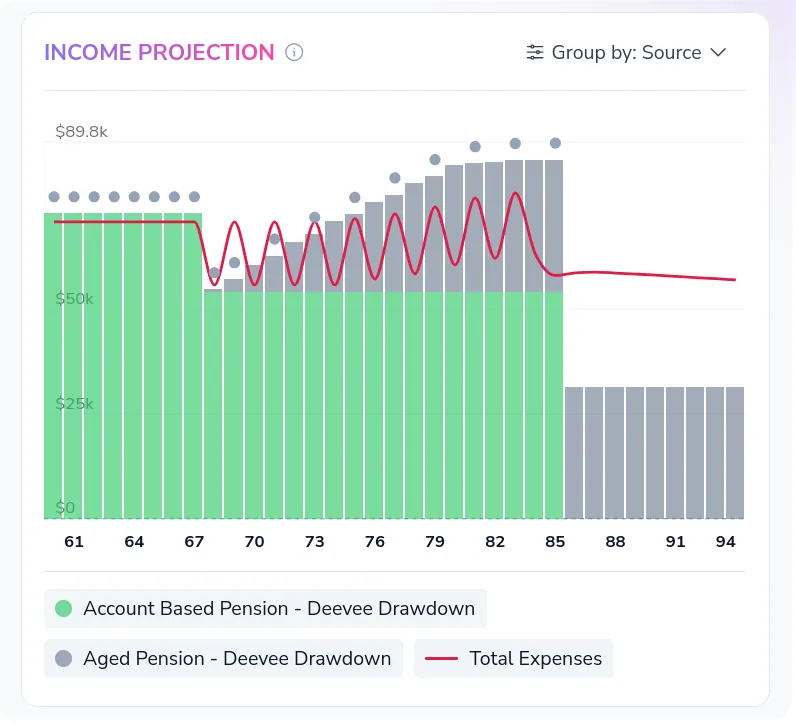
This works out to roughly $72,000 a year from her super in today's dollars for the first 7 years, then $54,000 a year until age 85. The pension supplements her income throughout, and from age 85 she'd have around $415,000 in cash savings to see her through the rest of her life.
View Deevee's spend big scenario in Canwi
Here's a video going over how I set up this scenario:
Scenario 2 - Deevee: conservative drawdown
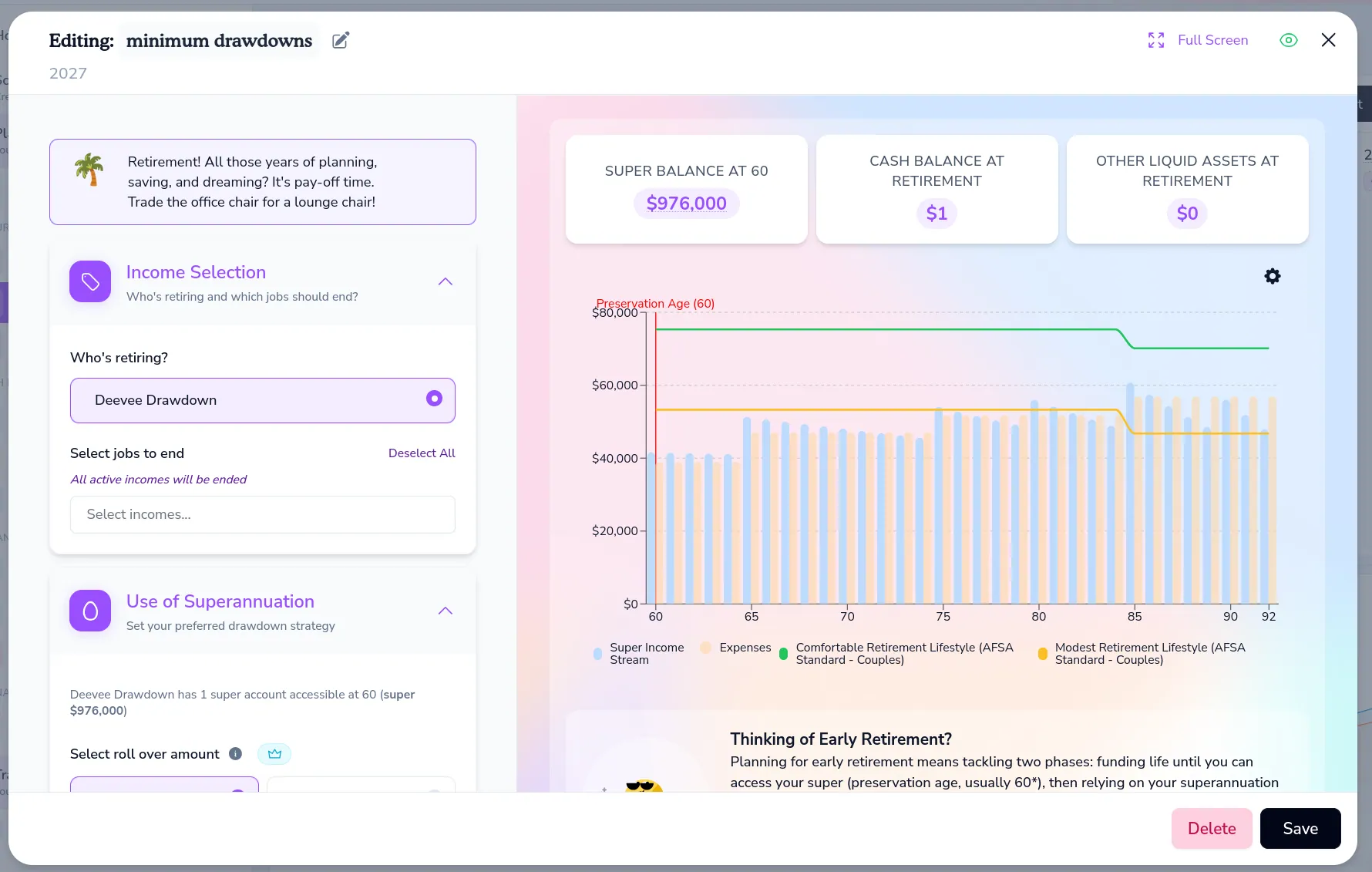
What if Deevee is more cautious about running out of money? She could opt for minimum drawdowns from her super instead. The trade-off: she'd need to cut all holidays and reduce her expenses by 30% at the start of the plan.
The upside is that by preserving her capital, she ends up with over $1 million remaining in her account-based pension at age 94. But this approach also means less income and spending across her whole retirement. Whether that trade-off is worth it depends on what matters to her.
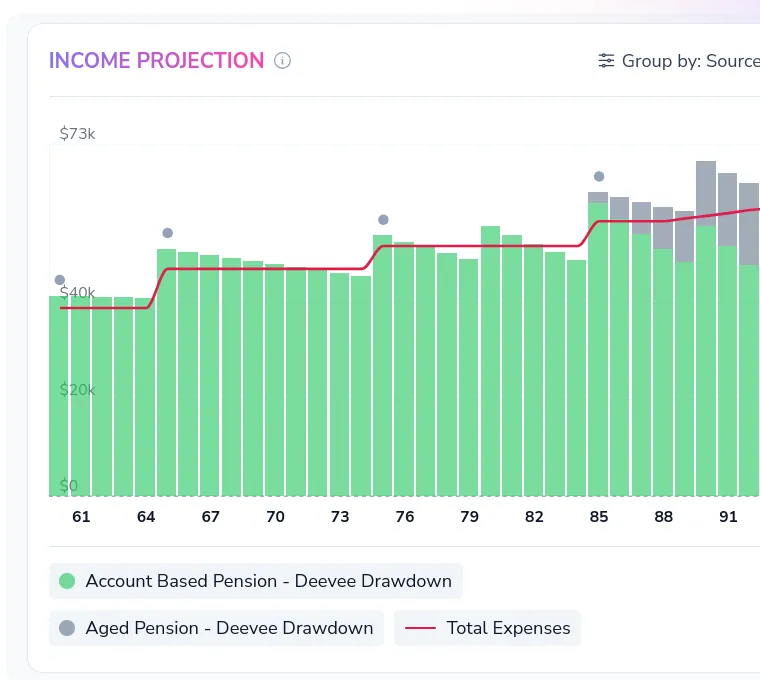
We can also compare both of Deevee's scenarios side by side in Canwi - her conservative drawdown on the left, her spend-big approach on the right:
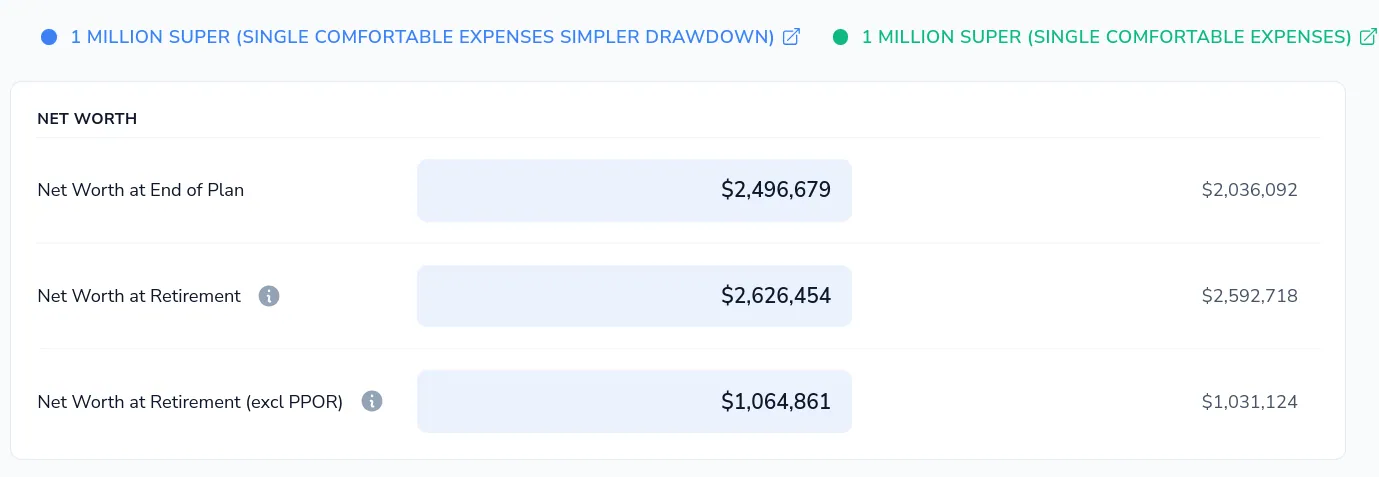
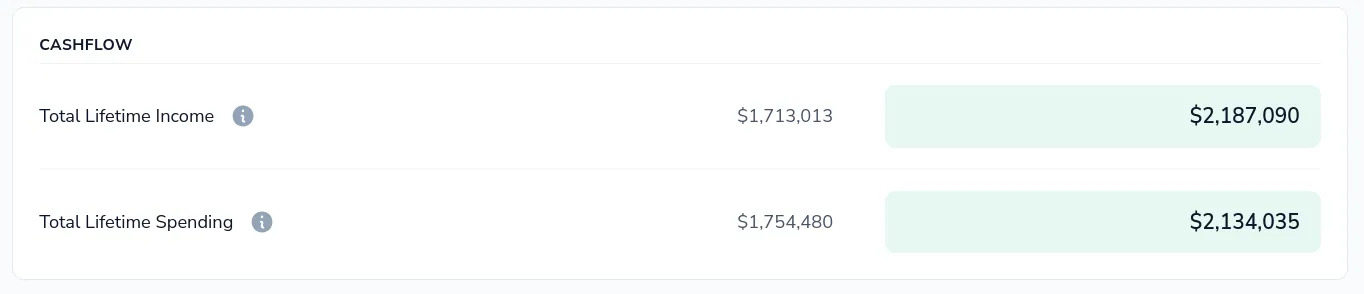
View Deevee's conservative drawdown scenario in Canwi
Scenario 3 - Pedro and Michelle: help family and hit the road
Pedro and Michelle also have $1 million in super between them, but their priorities are different. They want to help their two adult children with a home deposit, buy a camper van, and tour Australia. The grey nomad lifestyle.
They gift money to their kids first - at age 61, which sits outside the 5-year gifting rule for the Age Pension at 67. (You can read more about how gifting affects your pension entitlement on the Services Australia website.) They then buy the camper van and start travelling. They don't run out of cash and don't need to reduce expenses as they age.
View Pedro and Michelle's scenario in Canwi
Scenario 4 - Harrison: retiring as a renter
What if you don't own your home? Harrison has $1 million in super, modest lifestyle expenses, and pays $393.62 per week in rent after rent assistance. We modelled his rent increasing at 4% per year rather than the standard inflation rate.
Even with rent as an ongoing cost, Harrison can still afford a few $10,000 holidays until age 67, then $15,000 holidays every two years after that - and still has surplus cashflow by age 85.
View Harrison's scenario in Canwi
Aged care funding is a bit more complex as a renter - there's no property to fall back on. But Harrison has the capacity to build a cash buffer for this if he plans ahead. Alternatively, he could purchase an apartment or look at alternative housing (like a tiny house) early in retirement if he wanted to put down roots somewhere.
Is it realistic for a renter to have $1 million in super?
More realistic than you might think. A 20-year-old minimum wage worker earning $1,004.90 per week could have nearly $1.2 million in super in today's dollars by age 67 - assuming they're invested in a high-growth portfolio until 55, then switching to balanced. Here's the Canwi scenario that models that.
A minimum wage worker probably can't afford property today. But super may well be their primary wealth-building tool - and the compulsory system means they're accumulating whether they think about it or not.
Where does that leave us?
Retiring with $1 million isn't exactly struggle street - even for a renter. It isn't lavish, and there will be periods that require watching the budget. But across all four scenarios, $1 million in super provides a workable foundation for a genuine retirement - particularly with the Age Pension as a safety net.
If you have higher expenses, specific goals for that money, or you don't own your home, $1 million may not be enough. The right number is personal - which is exactly why modelling your own scenario matters more than any general rule of thumb.
This post is general information only and is not financial or superannuation advice. All scenarios are hypothetical and illustrative only. Individual outcomes will depend on your personal circumstances, investment returns, expenses, and eligibility for the Age Pension. Speak to a registered financial adviser for advice tailored to your situation.

 Sam

 Cam