







- Tax
The 2026 Federal Budget: what changed for your finances
 Cam6 min read
Updated
CGT is being overhauled. Negative gearing on established properties is changing. And workers are getting a new tax offset. Here's what was announced and what it means in practice.
Capital gains tax - the new rules
From 1 July 2027, the 50% CGT discount for individuals and trusts is being replaced with a different model. Rather than halving the nominal gain, investors will instead index their cost base to inflation (using CPI), and then pay tax on the "real" gain only - subject to a minimum 30% tax rate on any net capital gain.
The practical effect: investors who previously used the 50% discount to significantly reduce their CGT bill - especially those with modest marginal rates - will likely pay more tax on gains accruing after 1 July 2027.
The minimum 30% rate is designed to prevent high-income earners from deferring gains to low-income years to avoid tax.
How CGT on investment assets changes
| Scenario | Current rules | From 1 July 2027 |
|---|---|---|
| All CGT assets held 12+ months (individual) | 50% discount on gain, taxed at marginal rate | Cost base indexed to CPI; minimum 30% tax on real gain |
| *New* residential property (investor) | 50% discount | Choice: keep 50% discount OR use new indexation + min 30% rate |
| Superannuation fund | 33.3% discount | No change |
| Assets already owned before 1 July 2027 | 50% discount applies to full gain | 50% discount on gains up to 1 July 2027; new rules only on gains from that date forward |
| Age Pension / JobSeeker recipients | 50% discount | Exempt from the minimum 30% rate |
Negative gearing - what's changing and for who
Currently, if your investment property costs more to hold than it earns in rent, those losses can be offset against your salary or other income to reduce your tax bill. From 1 July 2027, that flexibility is being restricted for established residential properties.
Under the new rules, losses on established residential properties can only be offset against other residential property income or gains - not wages. Losses can be carried forward and used in future years. New builds remain fully negative gearable - losses from eligible new builds can still be offset against wages and other income.
Negative gearing - transitional rules at a glance
| When you bought | Negative gearing against wages? |
|---|---|
| Held before Budget night (12 May 2026) | ✓ Yes - grandfathered indefinitely |
| Purchased between 13 May 2026 and 30 June 2027 | Partially - allowed until 30 June 2027 only |
| Purchased from 1 July 2027 onward (established) | ✗ No - losses ring-fenced to property income |
| Eligible new build (any timing) | ✓ Yes - fully negative gearable, no change |
Working Australians Tax Offset
A new permanent $250 Working Australians Tax Offset (WATO) will apply from the 2027–28 income year. It's automatically applied after lodging your tax return - no separate claim required. It's available to Australian residents earning income from wages, salaries, or sole trader business income.
Combined with the already-announced income tax rate cuts (the 16% rate on income between $18,201–$45,000 drops to 15% from 1 July 2026, and to 14% from 1 July 2027), the government estimates a worker on average earnings of around $81,000 could be up to $2,816 better off per year by 2027–28 compared to the current settings. That figure is nominal - it doesn't account for inflation, and in real terms the benefit is smaller.
Updated tax rates - bottom bracket
| Income range | 2025–26 | 2026–27 | 2027–28 |
|---|---|---|---|
| $0 – $18,200 | Tax free | Tax free | Tax free |
| $18,201 – $45,000 | 16% | 15% | 14% |
| $45,001 – $135,000 | 30% | 30% | 30% |
| $135,001 – $190,000 | 37% | 37% | 37% |
| $190,001+ | 45% | 45% | 45% |
The WATO also lifts the effective tax-free threshold to just under $19,985 from 2027–28 (or up to $24,985 for those also eligible for the Low Income Tax Offset).
What about super?
Super was largely left alone in this budget. There were no new measures of significance announced for superannuation.
Importantly, the CGT changes do not apply to super funds. Superannuation funds - including SMSFs - will continue to apply the existing 33.3% CGT discount on assets held more than 12 months, and the new minimum 30% tax rate on net capital gains will not apply to them. Properties held inside super are also excluded from the negative gearing changes.
What this means for your plan
These are the biggest changes to investment property tax settings in a generation, and they're phased - so timing matters. If you're modelling a property purchase, your cashflow projections after 1 July 2027 will look different depending on whether the property is an established home or a new build, and when you bought it.
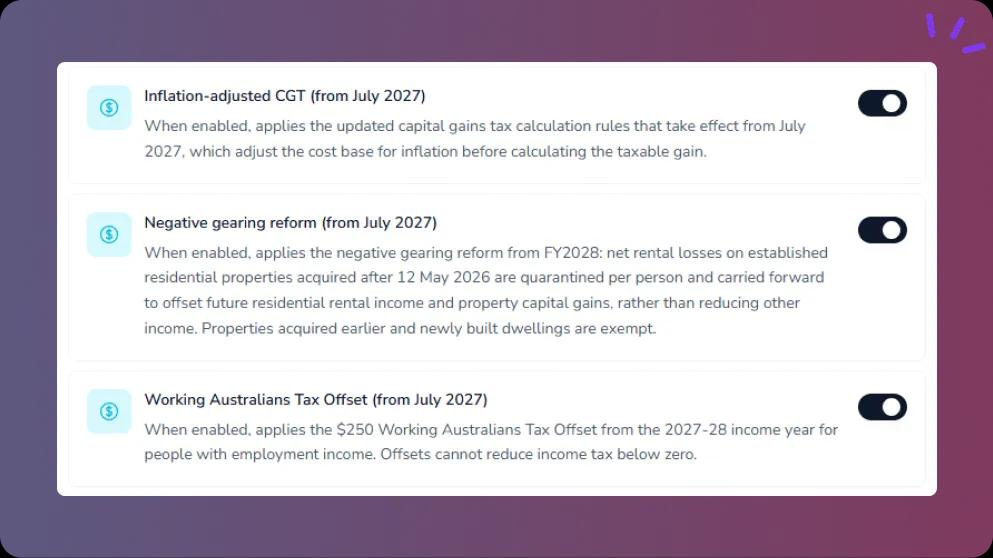
Canwi will be updated in the coming days to reflect the new CGT and negative gearing rules. Once live, you'll be able to model the impact directly with model settings in place to switch between the two systems - seeing how the changes affect your cashflow, tax position, and net worth over time, all in one place.
This post is general information only and is not financial or tax advice. The rules described reflect announcements from the 2026–27 Federal Budget and are subject to the passage of legislation. Speak to a registered tax agent or financial adviser for advice tailored to your situation.
 Cam