





- Tax
- Foundations
- Property
How to model rentvesting in Canwi, step by step
 Cam18 min read
Rentvesting means renting where you want to live and buying an investment property somewhere you can afford. It lets you get into the market without giving up the suburb you live in.
Whether it works for you depends on a handful of numbers that interact: the rent you pay, the rent you receive, loan repayments, property costs, tax, and what the property might be worth in 10 or 20 years. This guide sets all of them up in Canwi using an example plan, with a screenshot of each step.
This is the first of three posts. The second models living in the property first and then rentvesting. The third models buying a home to live in and investing on the side, then compares all three.
How rentvesting works in your plan
A rentvesting plan has two moving parts. You keep paying rent as a living expense, and you own an investment property that earns rent and creates costs, some of which are tax deductible.
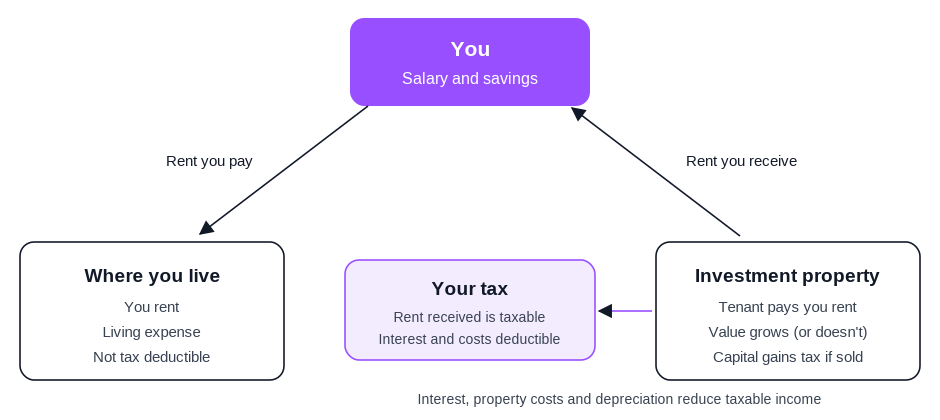
How money moves in a rentvesting plan.
Canwi handles the tax side for you. Once the property is in your plan, rental income is added to the owner's taxable income, and loan interest, property expenses and depreciation are claimed as deductions.
The example we'll use
We'll build a plan for Alex. The numbers are illustrative, not a recommendation.
| Age | 32 |
| Salary | $120,000 a year |
| Rent paid | $750 a week, in Sydney's inner west |
| Other living expenses | About $33,000 a year |
| Savings | $130,000 |
| Super | $75,000 |
| The plan | Buy a $600,000 established unit in Brisbane and keep renting in Sydney |
Want to follow along? Explore Alex's plan in Canwi ->
Step 1: Set up where you are today
Your plan needs an accurate starting point. If you've already built your plan, check your income, rent and savings before adding the property.
Income. Go to Plan → Cash Flow → Income and make sure your salary is up to date.
Rent. Go to Plan → Cash Flow → Expenses and click Edit Expenses. Add your rent as a line item with the amount and how often you pay it. Alex has it in a Fixed Costs / Bills bucket at $750 a week, which Canwi turns into $39,000 a year.
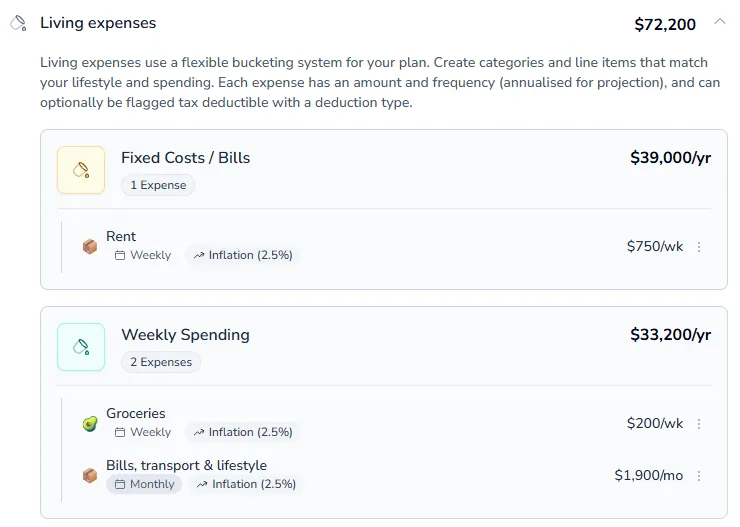
Rent sits in your living expenses like any other bill.
Rent on the home you live in isn't tax deductible, so leave Tax Deductible off.
Expenses grow with inflation by default (2.5% a year). Rents have often risen faster than that, and you'll pay rent for as long as you rentvest, so set this one deliberately. Click the rent line, turn on Custom Rate, choose Rate + Offset, and set the base rate and offset. Alex uses Inflation + 1%, so rent grows 3.5% a year. The Summary at the bottom confirms how Canwi will treat it.
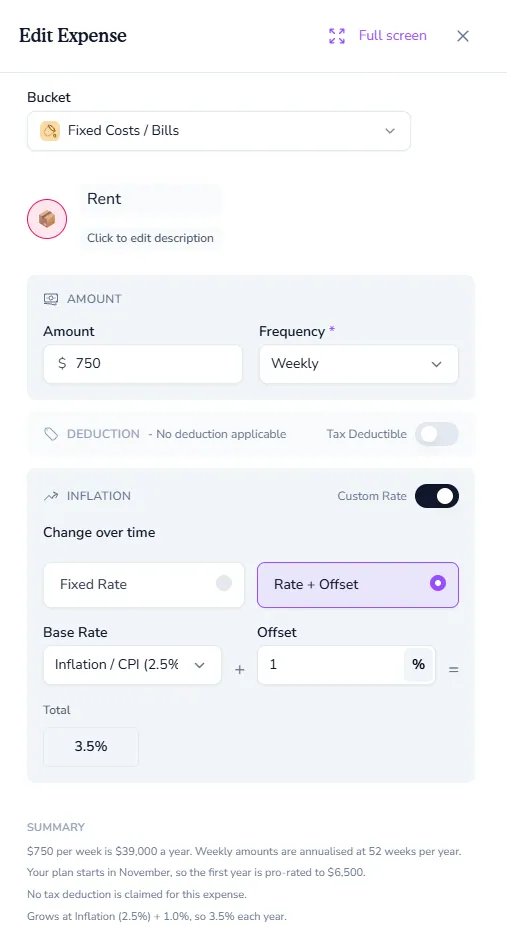
A custom growth rate for rent: inflation plus 1%.
Savings. Make sure the cash you'll use for the deposit is in your plan under Plan → Balance Sheet → Assets. Canwi draws on it when you buy.
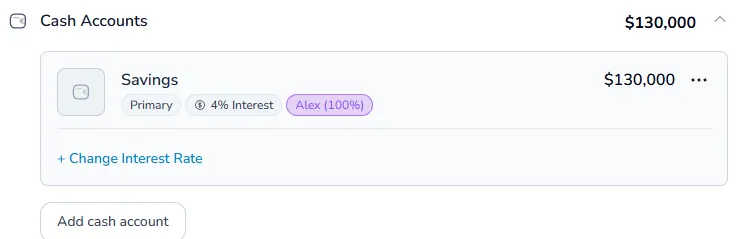
The savings that will fund the deposit and purchase costs.
Step 2: Check your money flows
Money flows tell Canwi what to do with spare cash each year, and how to cover a year where you spend more than you earn. Find them under Plan → Cash Flow → Money Flows.
By default, any surplus is saved to cash, and shortfalls are covered from your cash accounts in a set order. That suits Alex, who is saving towards a deposit. If you'd rather put surplus towards extra loan repayments or shares after you buy, change it here with Edit excess cashflow priorities.
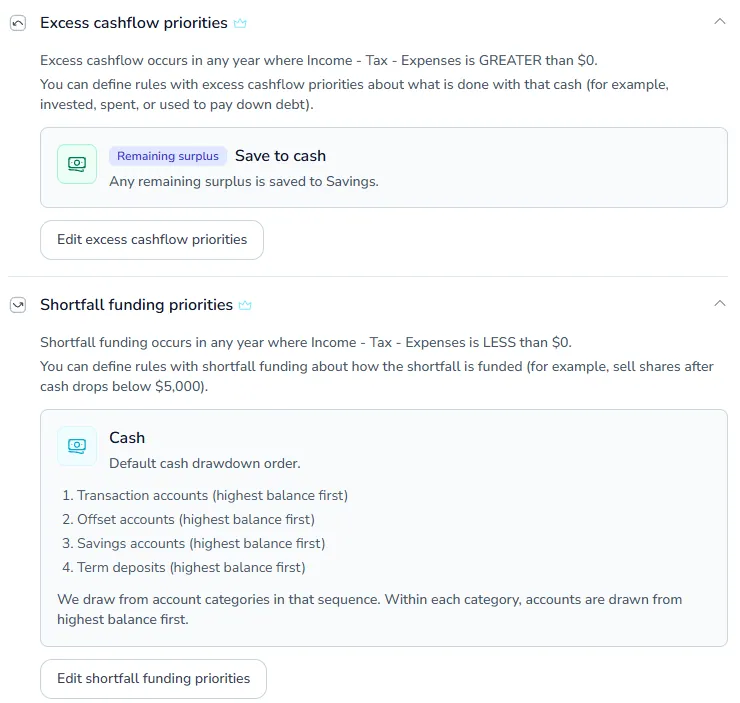
Money flows decide where surplus cash goes and how shortfalls are covered.
Step 3: Add the Buy Investment Property event
Go to Plan Builder and click Add New Event. Under Property & Vehicles, drag Buy Investment Property onto the year you plan to buy. You can also hover over a year on the timeline and click + Add Event.
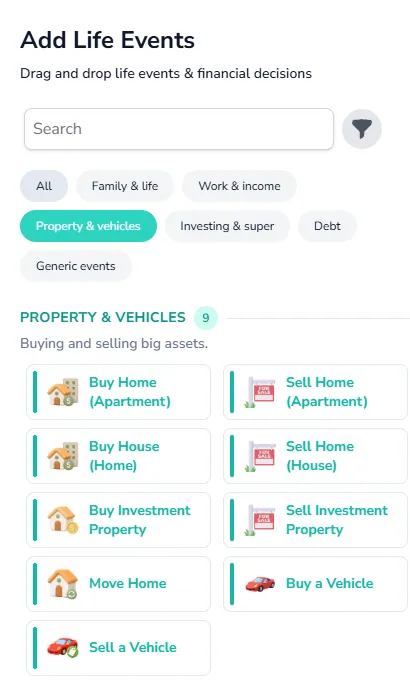
Buy Investment Property is under Property & Vehicles.
The event opens with a form on the left and a live preview on the right. Work through each section.
Property value and costs
- Property Value: what you expect to pay. Alex enters $600,000.
- Inflation: the Adjust for inflation toggle adjusts values for inflation at your plan's rate (2.5% by default).
- Additional Costs: Canwi estimates Stamp Duty for the state you choose, plus Other one-offs like legal and inspection fees. You can override either.
- Land Usage: Established Home or New Home. This decides how the negative gearing changes apply (more on that below).
- First Home Buyer: set this to No for an investment property. First home buyer concessions generally require you to live in the home.
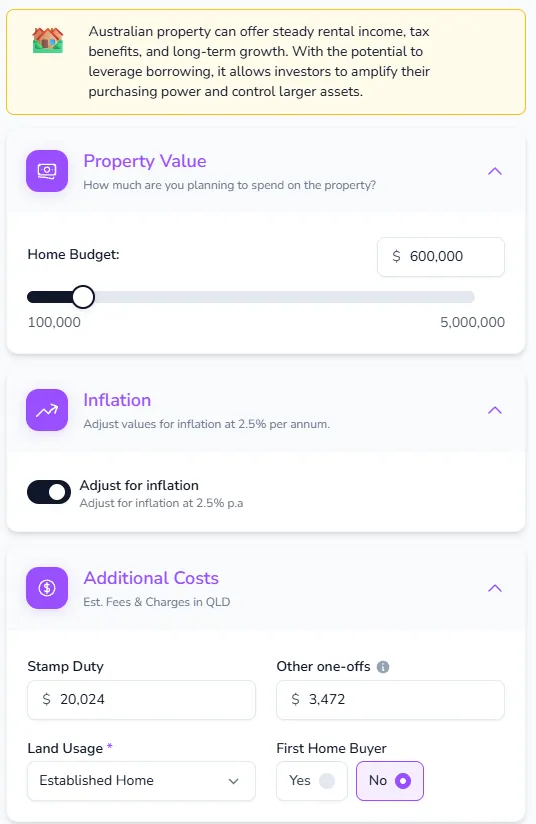
Price, inflation and purchase costs. Stamp duty updates when you change the state.
Asset and mortgage details
- Who will own the property?: if you're buying with a partner, Canwi splits rental income, deductions and capital gains tax by ownership share. Turn on Custom split for anything other than 50/50.
- State: where the property is. Alex picks QLD, and stamp duty comes to $20,024.
- Growth rate: how fast you expect the property's value to grow each year. Enter the headline rate, not an inflation-adjusted one. Alex uses 3.5% (see "Choosing growth and yield" below).
- Mortgage Details: your Deposit Amount, Interest Rate, Repayments (Principal & Interest or Interest Only), Loan Term and any Lenders Mortgage Insurance. Alex puts down $120,000 (20%) and borrows $480,000 at 6.2% over 30 years. You can also create an offset account for the loan here.
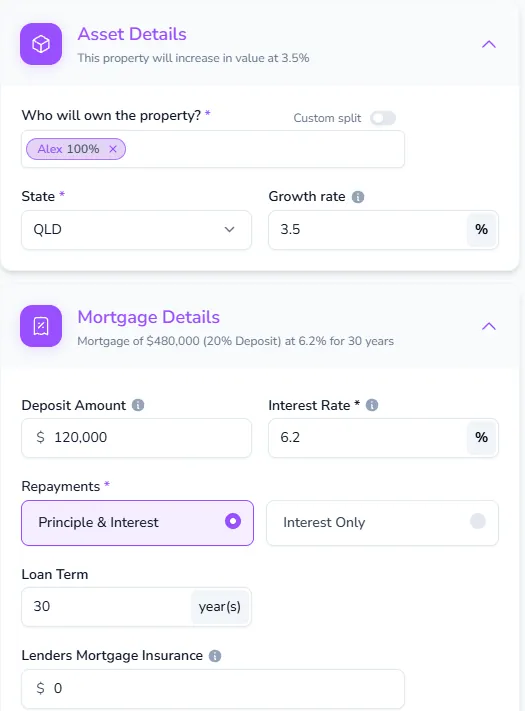
Ownership, growth rate and the loan.
Rental income and expenses
- Rental Yield: yearly rent as a percentage of the property's value. Canwi shows the weekly and annual rent it works out to. At 4%, Alex's unit earns $462 a week, or $24,000 a year. Rent then grows with the property's value.
- Annual Expenses: one yearly total for council rates, strata, insurance, repairs and property management. Alex uses $9,000.
- Yearly Depreciation and Years: from a quantity surveyor's depreciation schedule, if you have one. Depreciation reduces tax without any cash leaving your account. Alex uses $3,000 a year for 15 years.
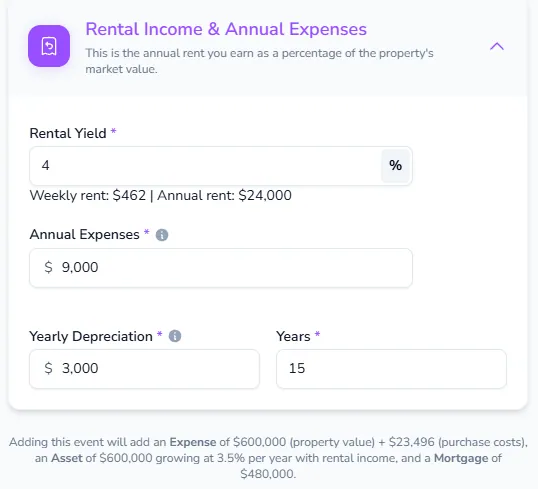
Rent, running costs and depreciation.
The preview on the right updates as you edit: up-front cost, monthly repayments, monthly rental income, and the loan and equity over time. For Alex, that's $143,496 up front and $2,940 a month in repayments against $2,000 a month in rent.
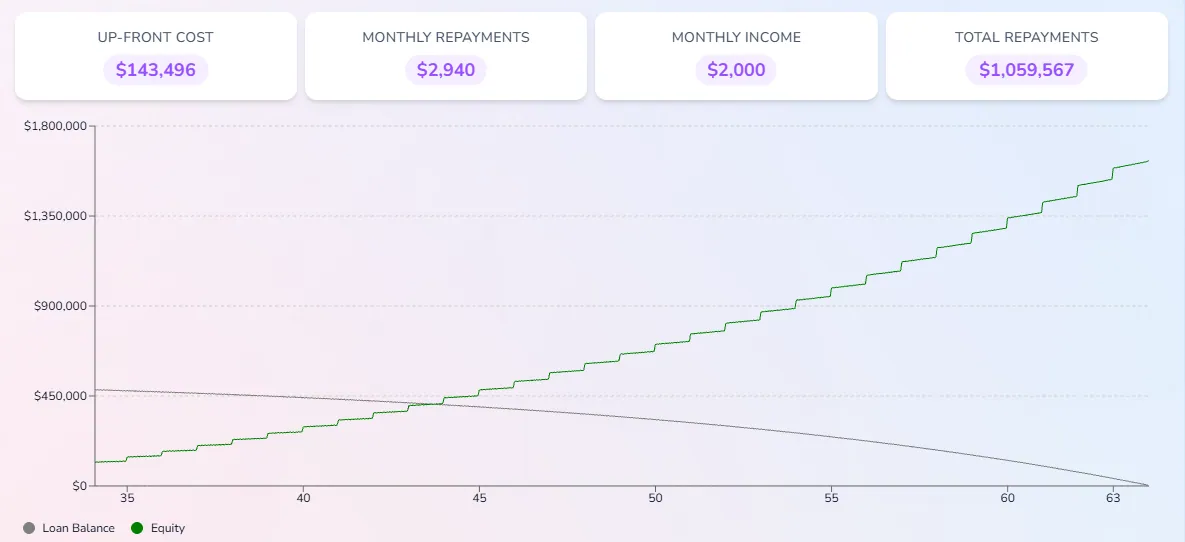
The live preview shows the purchase on its own, before you add it to your plan.
Choosing growth and yield
Growth and yield are the two inputs most likely to make a property plan look better than it should, and in Canwi they work together. Rent is a percentage of the property's value, so a high growth rate also grows the rent. A high yield paired with high growth double-counts.
A useful check is the total: growth plus yield. Alex's 3.5% growth and 4% yield add up to a 7.5% gross return, or about 6% after the $9,000 of running costs. That sits within the 6.5% to 8.5% range Australian property has typically returned over 10 to 20 years, before interest and tax. Brisbane units currently yield around 4%, and 3.5% growth is 1% a year above inflation.
The growth rate deserves the most thought. It's worth asking whether the conditions behind the last 30 years, like interest rates falling from double digits to near zero, can repeat over the time you'll hold the property. At 6.5% a year, a $600,000 property becomes about $2.1 million in 20 years. At 3.5%, it becomes about $1.2 million. Try both and see how much of your plan rests on that one number.
When you're happy, click Add. Canwi recalculates your whole plan straight away.
Step 4: Read the results
Look at what the purchase does to your cashflow, your tax and your net worth.
Cashflow
Alex's first attempt was to buy in 2027. The timeline flagged Out of cash for four years, with overdrafts of up to $3,223. Paying $2,940 a month on the loan while receiving $2,000 in rent leaves a gap Alex's salary couldn't quite cover in the early years.

Buying in 2027: four years of small overdrafts.
Dragging the event one year later fixed it. With an extra year of savings, buying in 2028 draws $145,967 from savings that year and $1,352 the next, then Alex is back to Saving every year after.
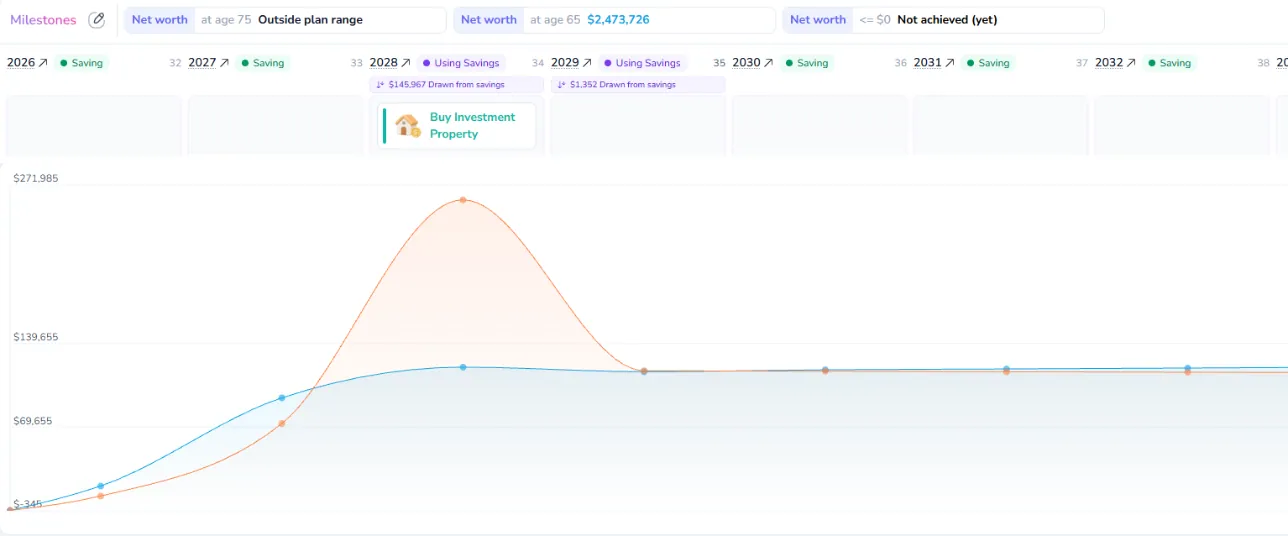
Buying in 2028: two years drawing on savings, then saving again.
A year or two of negative cashflow is normal. What matters is whether your plan runs out of cash. If it does, Canwi shows an Out of cash warning on the year it happens, and you can move or change events until it clears.
Yearly Financial Breakdown
Click any year on the timeline to open the Yearly Financial Breakdown. The Cash Flow Summary shows where every dollar comes from and goes. In 2030, Alex earns $138,770 in salary and $27,011 in rent, pays $37,064 on the investment loan and $35,619 in tax, and saves $839.
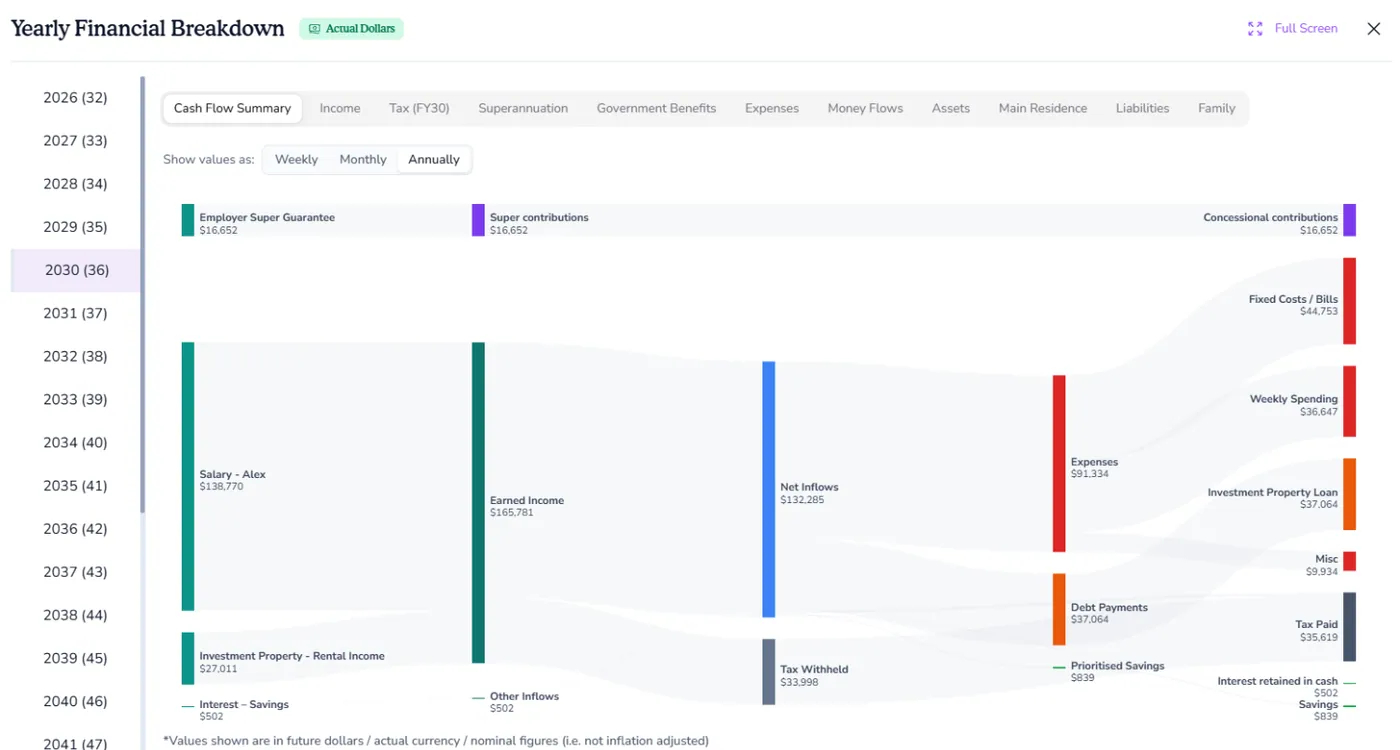
Every dollar in and out for 2030. The breakdown shows actual (future) dollars.
The Tax tab shows how the property affects your tax. Hover over Deductions for the detail. Alex's property costs $43,605 to hold in FY30 (interest, expenses and depreciation), but only $26,554 is deducted that year. The other $17,051 is carried forward under the new negative gearing rules, covered below.
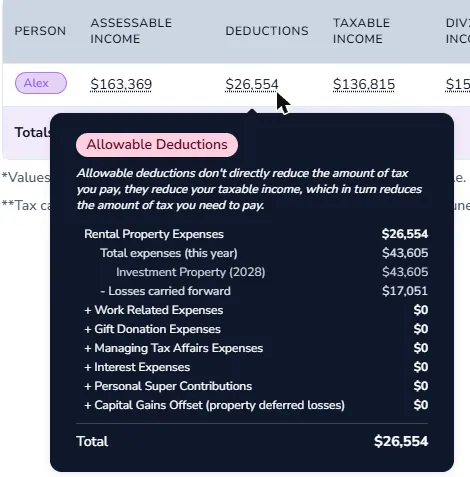
Losses on an established property are carried forward instead of reducing tax on salary.
Property value and net worth
Go to Plan → Balance Sheet → Home & Real Estate to see the property's value, the loan and your equity over time.
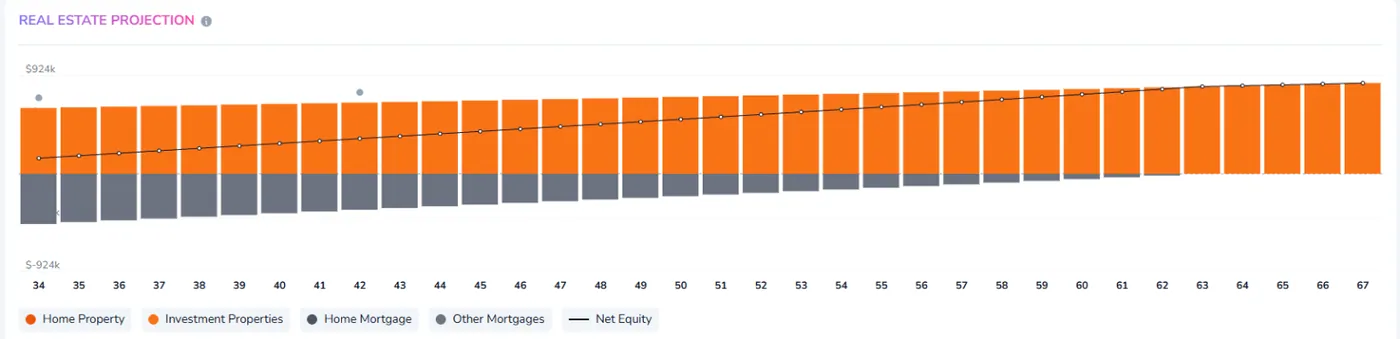
Value, loan and equity across the plan, in today's dollars.
The Projected Wealth chart on the Home screen shows how the property fits with your super and savings. Holding the property, Alex's projected net worth at 65 is about $2.47 million in today's dollars, compared with about $1.96 million without it.
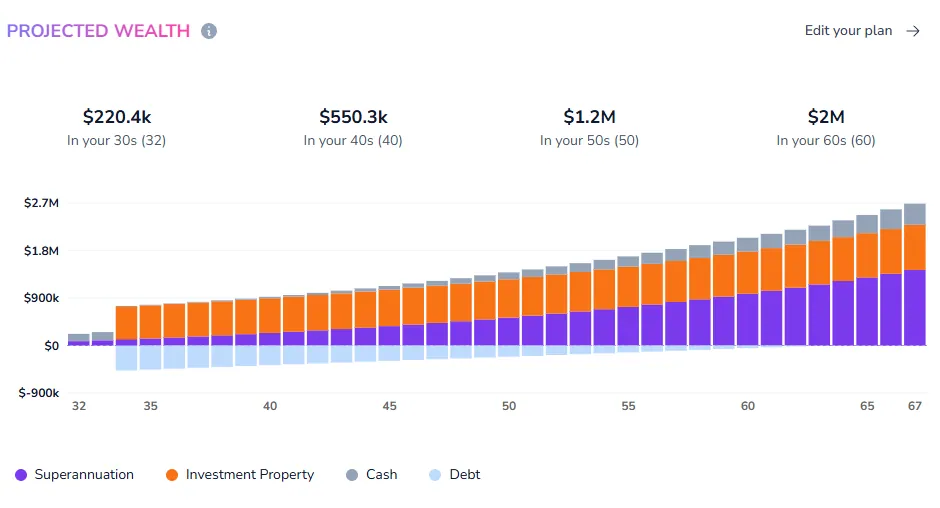
Projected wealth, in today's dollars.
Outputs default to today's dollars, so future amounts are adjusted for inflation. Switch to actual dollars at the top of the screen to see the numbers as they'd appear at the time.
Step 5: Plan what happens next
Most rentvesters don't plan to hold forever or rent forever. If you keep the property for the whole plan, it keeps growing at the rate you set, and over decades that rate drives a large share of your net worth. Add an event for what you expect to happen.
Sell it. Add a Sell Investment Property event in the year you'd sell, and pick the property. Canwi works out the sale costs, pays out the loan and calculates capital gains tax. If Alex sells in 2036, the unit is projected to be worth $830,083, leaving $347,682 in cash after the $444,450 loan and sale costs, with a $166,356 capital gain.
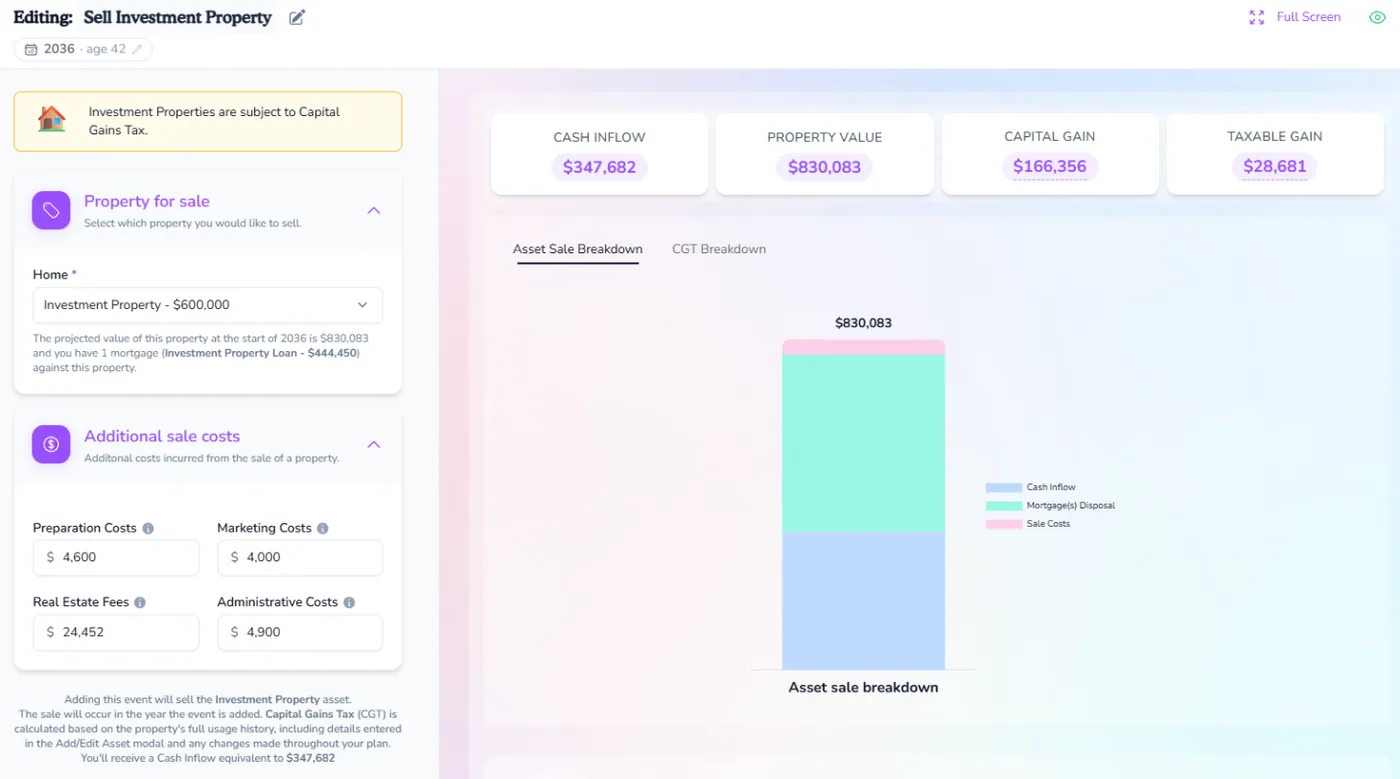
Selling in 2036: what's left after the loan and sale costs.
Hover over Taxable Gain to see how the gain is taxed. Alex bought after 1 July 2027, so the whole gain falls under the new rules: the cost base is indexed for inflation, which takes $137,676 off the gain and leaves $28,681 taxable.
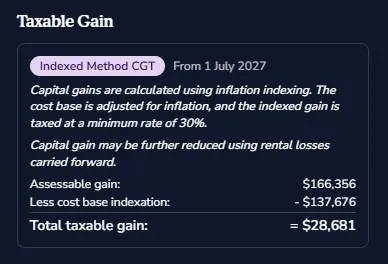
Under the indexed method, only the gain above inflation is taxed.
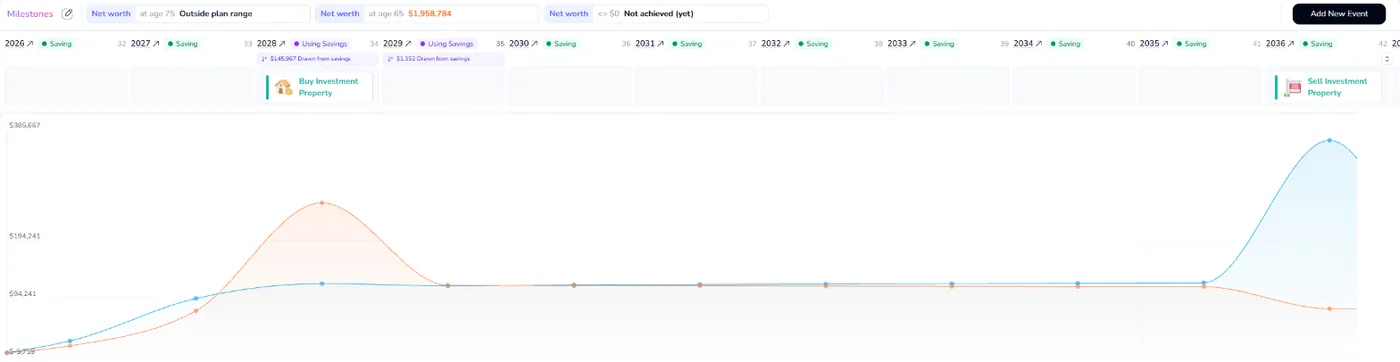
The full rentvesting plan: buy in 2028, sell in 2036.
After the sale, Alex's projected net worth at 65 drops back to about $1.96 million, roughly where it would be without the property. The proceeds sit in cash, which grows more slowly than the property did. A sale is usually a step towards something else, like a deposit on a home to live in, so model that next step too.
Move in. If you'd rather live in the property later, add a Move Home event and stop your rent from that year with a Change Expenses event. Canwi tracks the property's usage history, which affects how much capital gains tax applies if you sell later.
Step 6: Test your assumptions
Change one input at a time and watch the whole projection update. Click the event on the timeline to edit it, then try:
- a lower growth rate on the property
- an interest rate 1 to 2 percentage points higher
- Interest Only instead of Principal & Interest
- a lower rental yield, or a few months without a tenant
- a faster rise in the rent you pay
- buying a year earlier or later
With Canwi Plus, you can also run Chance of Success to see how your plan holds up across a range of market conditions rather than a single set of returns.
Things to factor in
Negative gearing changes
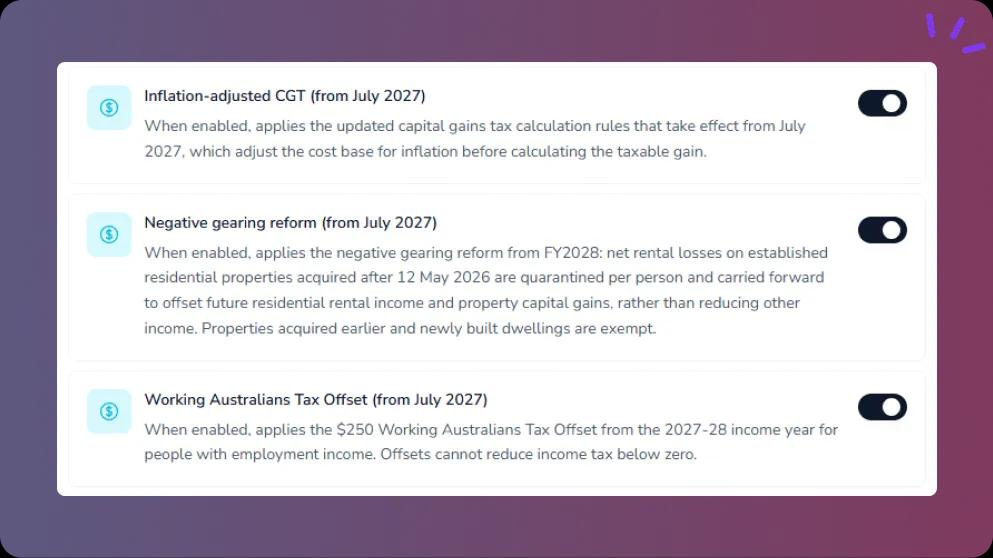
Under changes announced in the 2026-27 Federal Budget, from 1 July 2027 negative gearing on residential property will be limited to new builds. If you buy an established property after 7:30pm AEST on 12 May 2026, rental losses from 1 July 2027 can only be used against rental income or capital gains from residential property, and can't reduce tax on your salary. Losses that can't be used are carried forward. Properties held before that time are exempt, and new builds can still be negatively geared.
That's why the Land Usage field matters, and why Alex's deductions are capped in the example above. For a rentvester buying an established property, it can noticeably raise the after-tax cost of holding it. Canwi applies these rules based on what you select. For more on the settings behind this, see how to model the CGT and negative gearing changes.
Capital gains tax
A property you've never lived in doesn't get the main residence exemption, so capital gains tax applies when you sell. The Budget also replaces the 50% CGT discount with indexation and a minimum tax from 1 July 2027, with gains before that date still eligible for the discount. Canwi works this out when you add a sell event, as shown above.
The main residence exemption itself wasn't changed by the Budget. How it applies depends on when the property is your home, so the order you do things in matters.
Moving into your investment property later. If you buy an investment property and later make it your home, you'll generally get a partial exemption. The years it was rented stay taxable, and the gain is roughly split by the number of days it was your home versus a rental. The 6-year rule below can't cover the years before you first lived there.
Living there first, then renting it out (the 6-year rule). If a property is your home first and you then move out and rent it, you can choose to keep treating it as your main residence for up to 6 years while it's rented. A few conditions apply:
- It has to have been your actual home before you rented it out.
- You can't treat another property as your main residence at the same time. Renting where you live doesn't count as owning one, which is why this suits rentvesters.
- If you move back in, the 6-year period starts again for your next absence.
- If it's rented for more than 6 years in one absence, the gain after that point is taxable, generally worked out from the property's market value when you first rented it out. It's worth getting a valuation at that time.
Our next post models exactly this: Alex buys a unit in Woy Woy, lives there for a year, then moves closer to the city and rents it out. Selling within 6 years, the taxable gain comes out at $0.
A word on intent. This only works if the property really is your home. Buying "as a home" on paper, with no intention of living there, doesn't qualify. The ATO looks at the facts, such as how long you lived there, whether your belongings were there, and the address you used for mail, the electoral roll and services. First home buyer concessions and owner-occupier loans usually come with their own requirements to live in the property, and penalties if you don't. If you're weighing this up, talk to a tax agent first.
The rental period still counts as an investment for other taxes. Negative gearing on an established property bought after 12 May 2026 is limited under the new rules while it's rented, even if it used to be your home. Canwi applies this automatically once the property becomes a rental.
First home buyer support
Most first home buyer support, such as state stamp duty concessions and first home owner grants, requires you to live in the property. Buying an investment property first can mean missing out on these, and some schemes won't apply to a later home either. Check the rules in your state before you decide.
Next up: live in it first, then rentvest
Alex's plan works, but holding the Brisbane unit adds about $500,000 to net worth at 65, and selling after 8 years adds close to nothing. Part 2 tries a different order: buy a home, live in it for a year, then rent it out and move. Part 3 models buying a home to live in and investing the difference, then compares all three plans side by side.
This article is general information only and doesn't take into account your objectives, financial situation or needs. The example is illustrative. Tax rules described here reflect announced changes that may be subject to legislation. Consider getting advice from a licensed financial adviser or tax agent before making decisions.

 Cam